I've obviously managed to get on a sci-fi media database. I received two emails in one day this week from TV station marketing people. TLC and Comedy Central both have new shows they'd like me to tell you about.
The Comedy Central show, Ugly Americans, may appeal to the young male audience. It's on the Comedy Central station after 10:30 PM for a reason. Ugly Americans is an animated show featuring various, somewhat less than human (or more than human?) creatures like zombies, devil women and vampires who all invade New York City. Well, invade is not really the right word. They act like freakily dysfunctional New Yorkers who can't last 60 seconds without alluding to sex. It premieres on St. Patrick's Day, believe it or not. It's very much like an animated, but smutty, Men in Black. Trailers can be viewed here.
TLC sent me a press release about Paranormal Court, their one-hour program in which psychic medium, Robert Hansen, helps families who have lost a loved one gain justice and closure. Hmmm. Sounds like Judge Spooky. March 27, 10 PM on TLC.
Now to MY news! A short memoir that I wrote about finding my sister, entitled "The Rosary" has gained new life. After a very long wait, the second anthology to pick it up is now available. The volume is called The Mystery of Fate: Common Coincidence or Divine Intervention? Read more about it and purchase it from Amazon or on the publisher's website. Can't wait to get my copy!
Finally, I learned of this article on writing, Writing a story - 12 important elements of dialog, by A. J. Barnet, on a LinkedIn group and thought it worth sharing. Barnet encourages the use of dialog and gives many basic tips on writing and dialog. I'm a dialogaholic. I still think I need to try screenwriting...
vote it up!
Friday, March 5, 2010


Tuesday, March 2, 2010
Female spec fic writers and romance in sf/f
What a tremendous response to my questions, "Why do I read more male SF writers?" posited last week. There were so many great suggestions (I did ask for them) of speculative fiction authors who happen to be female that I thought I would compile a list for my readers from the comments given last week. I love lists.
But before I dive into the list, I'd like to point you in the direction of Robert Appleton's posts on Romance: Bookvana and The Galaxy Express. Robert Appleton explores the topic of romance in speculative fiction and comes at it from a unique perspective, that of a male writing romantic speculative fiction. It's definitely worth checking out. There's also a book giveaway tied to the first blog I cited.
Now, the list, in no particular order, of speculative fiction authors who were mentioned that I should read if I want spec-fic without romance. Some of the commenters may have fudged a bit on the no-romance thing, but the list is still populated by authors they enjoy reading.
Mary Rosenblum
Octavia Butler
C.J. Cherryh
Connie Willis
Lois McMasters Bujold
Anne McCaffrey
Madeleine Le'Engle
Ursula K. LeGuin
Sharon Shinn
Andre Norton
Elizabeth Moon
Jo Clayton
Kathleen Ann Goonan
Julie Czerheda
Joan Vinge
Jacqueline Carey
Janet Kagan
Nancy Kress
Susanna Clark
Chris Moriarty
Linda Nagata
Robin Hobb
Steph Swainson
And the following list from Nancy Jane Moore:
Gwyneth Jones
Laurie J. Marks
Vonda N. McIntyre
Anne Harris
Brenda Clough
Sarah Zettel
Rebecca Ore
L. Timmel Duchamp
Sue Lange
Sheri Tepper
Suzette Haden Elgin
Suzy Charnas
Nisi Shawl
Nicola Griffith
Kelley Eskridge
Kelly Link
Mary Gentle
Lisa Tuttle
Molly Gloss
Andrea Hairston
And one commenter suggested looking at Women Writing Sci-Fi, Your Picks and Tip Tree Award winners.
That ought to keep us busy supporting female spec-fic writers! And don't forget to check out all of the fine ladies I've interviewed. A complete list can be found to the right.
vote it up!
But before I dive into the list, I'd like to point you in the direction of Robert Appleton's posts on Romance: Bookvana and The Galaxy Express. Robert Appleton explores the topic of romance in speculative fiction and comes at it from a unique perspective, that of a male writing romantic speculative fiction. It's definitely worth checking out. There's also a book giveaway tied to the first blog I cited.
Now, the list, in no particular order, of speculative fiction authors who were mentioned that I should read if I want spec-fic without romance. Some of the commenters may have fudged a bit on the no-romance thing, but the list is still populated by authors they enjoy reading.
Mary Rosenblum
Octavia Butler
C.J. Cherryh
Connie Willis
Lois McMasters Bujold
Anne McCaffrey
Madeleine Le'Engle
Ursula K. LeGuin
Sharon Shinn
Andre Norton
Elizabeth Moon
Jo Clayton
Kathleen Ann Goonan
Julie Czerheda
Joan Vinge
Jacqueline Carey
Janet Kagan
Nancy Kress
Susanna Clark
Chris Moriarty
Linda Nagata
Robin Hobb
Steph Swainson
And the following list from Nancy Jane Moore:
Gwyneth Jones
Laurie J. Marks
Vonda N. McIntyre
Anne Harris
Brenda Clough
Sarah Zettel
Rebecca Ore
L. Timmel Duchamp
Sue Lange
Sheri Tepper
Suzette Haden Elgin
Suzy Charnas
Nisi Shawl
Nicola Griffith
Kelley Eskridge
Kelly Link
Mary Gentle
Lisa Tuttle
Molly Gloss
Andrea Hairston
And one commenter suggested looking at Women Writing Sci-Fi, Your Picks and Tip Tree Award winners.
That ought to keep us busy supporting female spec-fic writers! And don't forget to check out all of the fine ladies I've interviewed. A complete list can be found to the right.
vote it up!
Saturday, February 27, 2010
M.K. Hobson on the grind and glory of writing

Meet Mary, aka M.K. Hobson. She's a creator of excellent humorous science fiction and fantasy, a member of Broad Universe and great fun to kick around with. Her first novel, Native Star debuts this fall closely followed by the second in the duology, The Desired Poison. She's the first to experience an interview with me face to face with my Blackberry recording. Email interviews are less work (for me, at least), but they're less interactive. See what you think.
(Photo by James W. Fiscus)
AW: When and how did your journey to speculative fiction begin? Both as a reader and a writer?
MKH: I definitely started reading speculative fiction quite young. Mostly starting with fantasy. Well, there was TV, obviously. I loved Fantasy Island. That was my favorite TV show when I was a kid. I thought Mr. Roarke was so freaking sexy. He was like my first crush I ever had. The first fan fic I ever wrote was fantasy island fan fic. That's a little embarrassing. I started reading, Ursula Le Guin, (The Earth Sea Tales were huge when I was probably 10, 11), a lot of Piers Anthony, which I just thought was absolutely hilarious. I thought the Xanth books were the sine qua non of fantastic, wonderful writing.
I found a little bit of what I liked in everything. I liked the humor of the Xanth books. I liked the beautiful writing of the Ursula K. Le Guin books. I liked the historical detail of the Little House on the Prairie books. But it was all just pieces. So, I guess, as a writer, I wanted to take all the elements that I really liked and make something out of them that I wanted to read.
AW: So when did you start writing?
MKH: I remember I used to write in notebooks when I was probably seven or eight. I would write stories and novels, as long as a novel was for me at that age in lined notebooks. When I was 10 or 12, my Mom brought home an Ozborn word processor. Remember those Osborn word processors, there was no operating system on it, you had to insert a floppy drive in it for it to have an operating system. She brought this thing home and I was agog. Actually, there was an intermediate stage between the notebook and the word processor, my Mom had a Selectric typewriter. There was something magical about typing.
And then she brought home the word processor. I just wanted to be on that thing all the time.
AW: Does it seem to you that women authors tend to put romance into their fiction? I believe there are more men reading SF than women so I write for them. And I find that I read mostly male authors. Is it a struggle for women to write for men?
MKH: It's not just romance. Women write about relationships.
In a lot of the sci-fi short fiction I've written, I've made conscious decisions keeping a male audience in mind. One of the stories I wrote for F and SF is called "Powersuit," and it is just a humorous little science fiction piece about a guy and his AI and it's told from a masculine point of view. It's a very masculine science fiction story and I found myself making choices in that story that I actually question like, 'I'm not really sure I like the way I'm depicting this woman in this story because she's kind of your typical sex object a bit,' but for some reason I was thinking that that's the audience that I'm writing for so I'm going to go a little more in that direction. And again, I don't know if that's the right choice. I don't know if that's an honorable choice to make but I think what you've put your finger on is very real.
And I definitely think that women are much more readers of fantasy as a category. I agree, men or women writing science fiction don't tend to think of women as being their readers. They follow the tropes and the expectations of what they think a male reader is going to want.
We live in a patriarchal culture; men are better at writing to the expectation of what is good writing. What is "good writing" is what is taught in colleges and what is decided on by critics. And critics and professors are mostly male.
There are female science fiction writers like Mary Rosenblum, for example. Louise Marley is fantastic. And Brenda cooper. I can think of four or five female science fiction writers in the Pacific Northwest alone, who are very good.
It's interesting, too, that they all write under female names. When I started writing science fiction, I very carefully chose a gender-neutral pseudonym because at that point I was writing a lot more sci-fi than fantasy. I thought that I had to do that to attract the male audience. Now when someone goes by their initials, they're assumed to be a woman.
I would love to hear about what those authors had to struggle with in terms of the expectations because they all write very hard science fiction.
AW: Where do you stand on the Google gobble?
As far as I can tell, it mostly affects people who already have stuff in print. As a relatively new writer, going through and looking at what I had in the Google database, it was pretty limited. It's a really hard question because I have many, many, many a time benefited from the Google search of books, to look up a citation or something. I'm not reading the whole book. The question becomes would I have gone out and bought the book to get that information? No. Is the world a better place because I'm able to find that information? I think so. It's definitely a better place for me. How much is it really impacting the people that actually put in the work? That's the question. Because, like I said, I wouldn't have gone out and bought the book so they're not losing any money on me. But I think over the aggregate it is an issue.
It's part of a much larger issue which is as creative individuals, as creators, who take the product of our mind and hope to get some tangible benefit out of it, we're being asked more and more to give a lot of our stuff away free, it's that loss leader mentality. And the problem with that is that there's just so much being given away for free. I do a lot of the research into class and class consciousness and it seams to me the creative people are being asked to sacrifice the most. And they're the ones who are already getting to be the most marginalized. Where we were once paid for our stories, now we're expected to be glad of and settle for the exposure. That disturbs me.
How that applies to Google? I think that Google's the camel's nose in the tent. We still have bills to pay. If I knew that I was going to have my housing paid for and my healthcare paid for and I lived in some kind of socialist paradise, I would say fine, I will just write beautiful things and everyone can read them, but we don't live in that world. We live in a horrible free market economy.
AW: Your process isn't linear. Can you describe it for my readers?
MKH: It comes to me in bits and pieces. I don't like the whole, 'it's my muse, it's my muse,' I think that's silly but definitely nothing comes to me and is revealed all at once. Light shines on different parts. And I think, "Oh, yeah, that would totally happen between those characters," and so I would write that scene. And that illuminates another area. For me, approaching a story is like walking thru a dark room with a flashlight. There was an Atari game called adventure. And u would go into this dark room and you would know nothing about the room or the maze or anything until you've gone through it. Once you've gone through enough of the maze, then things are revealed to you. I have no idea what a story is going to be until I start walking through it with my flashlight and then I know what feels right, like choosing the solid stepping stone to cross the river.
AW: Does it ever get away from you? How do you organize all the bits and pieces?
MKH I get very frozen at forks in the road. It's a lot like the iceberg, 95% is cogitating and working things through, and then 5% is writing. For me, the process is grinding; thinking as far ahead as I can, like several moves ahead in a chess game to figure out which way to go. You have to get to that one moment that stops you in your tracks.
AW: Then you work backwards sometimes?
MKH: Yeah, and it can take a long time to find the right course. I think a lot of people have this sort of process but it's not talked about as much. Writing 1K words a day is easier to blog about.
AW: I think it goes back to that inspiration thing we discussed earlier. If we're not inspired and crank out words to make a quota, it can be fodder that never makes the cut.
MKH: I never get big inspirations. I don't get inspired for a whole book. I get inspired for a scene. I envision a conversation or a fight scene.
AW: Do you start with plot, world, situation or character?
MKH: I think my first foundation of what I write is the "what if?" or the juxtaposition of two odd concepts. Like my book has 19th century America with magic. Taking two disparate concepts and fitting them together was very interesting to me. In my short fiction it's often not only juxtaposing different concepts but exploring interesting things in a different light. Like one of the stories I'm doing right now is about 1930s films with magic – a fantasy element to it. I find the secret true story thing fascinating. Everybody wants the real story to be more interesting than it actually was.
Learn more about M.K. Hobson.
vote it up!
Thursday, February 25, 2010
Why do I read more male SF writers?
I've been wrestling with an interesting dichotomy for a while. I'm hoping to stir some good non-healthcare related debate here. I belong to an organization which has as its sole purpose, the advancement of female-written speculative fiction, Broad Universe. I love my club. I have participated in it on many levels throughout the three years or so I've been a member.
Here's my problem. I'm an advocate of women writing speculative fiction because, well, I'm a woman, and more importantly, a woman who writes speculative fiction. But if I'm such an advocate, why do I read novels by men far more than those written by women?
Perhaps it's because I know I won't get any romance in my science fiction. Mind you, when I find romance, I get sucked in like any other warm-blooded female, but afterward, I feel cheated. I chose the book because it promised science fiction or fantasy. And I'm not your typical female. I don't like to shop. I don't like attending baby and bridal showers and Tupperware parties.
We know that men and women think and act differently, overall. Why assume that they will write the same? There have been a few women writers whom I've read that have managed to write a good story without the romance derailing the plot, but it seems like they are few and far between. When men do throw romance in, it's more like how I shop: get in, get out, go back to more important tasks. When men—and the few women who can pull it off like men do—write romance, they do it to add an additional layer to the plot, not to drive it. And when they don't throw in romance, I don't miss it.
From the beginning, when I first started writing science fiction, I assumed that men would comprise the majority of my audience. I thought, and still do, that more men read science fiction than women. That may not be true of fantasy. But I prefer science fiction with a few very special exceptions. Like I said, I'm not your typical female. I have always gravitated to the male conversation at a party. I don't want to talk about diets, shopping and fashion. Maybe it's not just the romance at all. Maybe it's because I prefer talking with men, so I prefer reading from their perspective.
Women are inherently more concerned with relationships. We have to be. We have historically been the ones nurturing the children. It's how we (well, most of us) were made. If you're a female spec-fic author, is it a constant struggle for you to write for a male or mixed audience and keep the romance at bay?
Or could it be that I read more male writers because the women aren't getting the same exposure? Many of the male writers I read are well-established, not an unknown quantity. Are there fewer women writing science fiction? Are there fewer of them getting published?
I want to hear from you. Tell me there are plenty of women who can write without including romance. And please, oh please, tell me who they are. Tell me I'm an unromantic cold-hearted woman. (I love romance out in the real world, by the way.) Or tell me you know what I mean. But don't be silent. Let the discussion begin!
PS – Tomorrow, an interview with a speculative fiction writer. ;)
vote it up!
Here's my problem. I'm an advocate of women writing speculative fiction because, well, I'm a woman, and more importantly, a woman who writes speculative fiction. But if I'm such an advocate, why do I read novels by men far more than those written by women?
Perhaps it's because I know I won't get any romance in my science fiction. Mind you, when I find romance, I get sucked in like any other warm-blooded female, but afterward, I feel cheated. I chose the book because it promised science fiction or fantasy. And I'm not your typical female. I don't like to shop. I don't like attending baby and bridal showers and Tupperware parties.
We know that men and women think and act differently, overall. Why assume that they will write the same? There have been a few women writers whom I've read that have managed to write a good story without the romance derailing the plot, but it seems like they are few and far between. When men do throw romance in, it's more like how I shop: get in, get out, go back to more important tasks. When men—and the few women who can pull it off like men do—write romance, they do it to add an additional layer to the plot, not to drive it. And when they don't throw in romance, I don't miss it.
From the beginning, when I first started writing science fiction, I assumed that men would comprise the majority of my audience. I thought, and still do, that more men read science fiction than women. That may not be true of fantasy. But I prefer science fiction with a few very special exceptions. Like I said, I'm not your typical female. I have always gravitated to the male conversation at a party. I don't want to talk about diets, shopping and fashion. Maybe it's not just the romance at all. Maybe it's because I prefer talking with men, so I prefer reading from their perspective.
Women are inherently more concerned with relationships. We have to be. We have historically been the ones nurturing the children. It's how we (well, most of us) were made. If you're a female spec-fic author, is it a constant struggle for you to write for a male or mixed audience and keep the romance at bay?
Or could it be that I read more male writers because the women aren't getting the same exposure? Many of the male writers I read are well-established, not an unknown quantity. Are there fewer women writing science fiction? Are there fewer of them getting published?
I want to hear from you. Tell me there are plenty of women who can write without including romance. And please, oh please, tell me who they are. Tell me I'm an unromantic cold-hearted woman. (I love romance out in the real world, by the way.) Or tell me you know what I mean. But don't be silent. Let the discussion begin!
PS – Tomorrow, an interview with a speculative fiction writer. ;)
vote it up!
Friday, February 19, 2010
Radcon recap #2 - the rest of the story
Radcon day 2 and 3, Feb. 13 and 14 were a blur! I'll try to capture the highlights and the mood. The pictures will help.
I had a rather late night on Friday, but I had to get up at a more or less reasonable hour to wedge in an interview with Laurel Anne Hill before her first panel. I miscalculated how much time I had and was moving pretty slow, so I ended up meeting Laurel before my morning infusion of caffeine. She was very good-natured about waiting with me at the hotel cafe's cashier/coffee bar. The wait was inordinate and when I finally got to the front, the newbie behind the counter was having technical issues. I decided to forego the tea and get on with the interview. Next problem was to find somewhere quiet to conduct the interview. In hind-sight, I should have just done it in the hotel room as opposed to the quiet, remote stairwell that suddenly became a preferred shortcut.
After a delightful interview, I headed off in search of tea, Earl Grey, hot. I had to settle for the only black tea in offing. But caffeine is caffeine.
Saturday was my day of characters. My panels were both on characters. The first focused on how to use them and keep them real and fun. That panel was made more fun by the fact that it included Kevin Shamel of Bizarro Fiction fame. Also on the panel were Christine Morgan and Forrest Armstrong. So what can I say? We kept it real. ;)
Before the next Character panel, I emceed and participated in the Broad Universe reading. I'd like to say we drew a crowd. We had a small but receptive audience - and he bought a copy of Awesome Lavratt. The lack of bodies might have been because of the location and the posters that proclaimed it #2 of the top ten things to do at Radcon, but gave the time as 2 hours after the scheduled time.
The second Character panel was on compartmentalized characters. G. David Nordley led us on an oddyssey of all the reasons why people and, in turn, characters might be compartmentalized and whether we can get away with portraying them in fiction. I think the consensus was that yes, you can, but give the reader a clue as to the reason or motivation for their seemingly split personality.
After a brief rest, I caught my buddy Irene Radford's reading.

After dinner with my buddies, the four muskateers got together in Maggie's (M.H. Bonham's) room to help her with her mead.

And Andrea (Howe of Blue Falcon Editing) was busily making Jayne hats. If you don't know what those are, you obviously haven't been introduced to Firefly, the best sf show ever. The other muskateer is sf/f writer S.A. (Sue) Bolich. I only managed to get one picture of her and she'll kill me if I post it.

Next up was John Pitts' birthday party / ARC give-away contest.

And here he is signing his first book, Black Blade Blues! An SFOO exclusive! ;)

Jay Lake was unable to make it to Radcon. Mark Ferrari, however, dressed up in Hawaiian shirt and fake bird and emceed the masquerade as Jay Lake. I missed it, but here he is sharing a picture of himself as Jay on an iPhone with Patrick Swenson of Talebones magazine and Fairwood Press at the small press party. Looking on are furry-costumed Edgar T. Lincoln and Shannon Page.

Lastly, on Saturday, I did my celebrity bartending gig with G. David Nordley in the Radcon to Reno bar, relieving Bob Brown and Larry Niven.
Here's the changing of the guard.

And here's Jerry and I. We did great business. I'm sure it was the March Hare Hat.
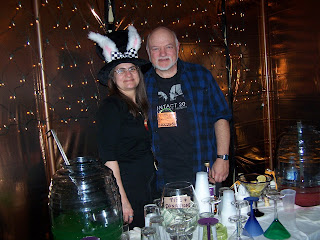
The green stuff was dubbed algae bloom and the red stuff was red tide. We also had rum and scotch shots. The scotch was very good.
Our replacements didn't arrive, so we ended up closing the party at 2AM. But if we'd been replaced I would have missed Dragon Dronet's solo sax performance.

Sunday, my roomie, Sue Bolich, and I stumbled into the cafe for caffeine and stayed for lunch. Friends came and went, and we bid farewell before we traveled homeward. I still had one panel first, on the difference between science fiction, fantasy and horror with Eileen Gunn, Ellen Datlow and C.J. Cherryh. I think I was still half asleep. I did, however, manage to pose the question, "Is all of this categorizing books into sub-genre's causing readers to forego being exposed to books beyond their norm, preventing them from expanding their horizons?" The panel was divided on that one. And then I managed to drop my cell phone under the table in that room, only realizing it after a trip to the dealer's room. By the time I got back the door was locked and the keys deactivated. But I didn't mind so much. My flight was a few hours later and I enjoyed my shiny new review copy of Jack Skillingstead's The Harbinger while I waited for the con staff to sort it out.
vote it up!
I had a rather late night on Friday, but I had to get up at a more or less reasonable hour to wedge in an interview with Laurel Anne Hill before her first panel. I miscalculated how much time I had and was moving pretty slow, so I ended up meeting Laurel before my morning infusion of caffeine. She was very good-natured about waiting with me at the hotel cafe's cashier/coffee bar. The wait was inordinate and when I finally got to the front, the newbie behind the counter was having technical issues. I decided to forego the tea and get on with the interview. Next problem was to find somewhere quiet to conduct the interview. In hind-sight, I should have just done it in the hotel room as opposed to the quiet, remote stairwell that suddenly became a preferred shortcut.
After a delightful interview, I headed off in search of tea, Earl Grey, hot. I had to settle for the only black tea in offing. But caffeine is caffeine.
Saturday was my day of characters. My panels were both on characters. The first focused on how to use them and keep them real and fun. That panel was made more fun by the fact that it included Kevin Shamel of Bizarro Fiction fame. Also on the panel were Christine Morgan and Forrest Armstrong. So what can I say? We kept it real. ;)
Before the next Character panel, I emceed and participated in the Broad Universe reading. I'd like to say we drew a crowd. We had a small but receptive audience - and he bought a copy of Awesome Lavratt. The lack of bodies might have been because of the location and the posters that proclaimed it #2 of the top ten things to do at Radcon, but gave the time as 2 hours after the scheduled time.
The second Character panel was on compartmentalized characters. G. David Nordley led us on an oddyssey of all the reasons why people and, in turn, characters might be compartmentalized and whether we can get away with portraying them in fiction. I think the consensus was that yes, you can, but give the reader a clue as to the reason or motivation for their seemingly split personality.
After a brief rest, I caught my buddy Irene Radford's reading.

After dinner with my buddies, the four muskateers got together in Maggie's (M.H. Bonham's) room to help her with her mead.

And Andrea (Howe of Blue Falcon Editing) was busily making Jayne hats. If you don't know what those are, you obviously haven't been introduced to Firefly, the best sf show ever. The other muskateer is sf/f writer S.A. (Sue) Bolich. I only managed to get one picture of her and she'll kill me if I post it.

Next up was John Pitts' birthday party / ARC give-away contest.

And here he is signing his first book, Black Blade Blues! An SFOO exclusive! ;)

Jay Lake was unable to make it to Radcon. Mark Ferrari, however, dressed up in Hawaiian shirt and fake bird and emceed the masquerade as Jay Lake. I missed it, but here he is sharing a picture of himself as Jay on an iPhone with Patrick Swenson of Talebones magazine and Fairwood Press at the small press party. Looking on are furry-costumed Edgar T. Lincoln and Shannon Page.

Lastly, on Saturday, I did my celebrity bartending gig with G. David Nordley in the Radcon to Reno bar, relieving Bob Brown and Larry Niven.
Here's the changing of the guard.

And here's Jerry and I. We did great business. I'm sure it was the March Hare Hat.

The green stuff was dubbed algae bloom and the red stuff was red tide. We also had rum and scotch shots. The scotch was very good.
Our replacements didn't arrive, so we ended up closing the party at 2AM. But if we'd been replaced I would have missed Dragon Dronet's solo sax performance.

Sunday, my roomie, Sue Bolich, and I stumbled into the cafe for caffeine and stayed for lunch. Friends came and went, and we bid farewell before we traveled homeward. I still had one panel first, on the difference between science fiction, fantasy and horror with Eileen Gunn, Ellen Datlow and C.J. Cherryh. I think I was still half asleep. I did, however, manage to pose the question, "Is all of this categorizing books into sub-genre's causing readers to forego being exposed to books beyond their norm, preventing them from expanding their horizons?" The panel was divided on that one. And then I managed to drop my cell phone under the table in that room, only realizing it after a trip to the dealer's room. By the time I got back the door was locked and the keys deactivated. But I didn't mind so much. My flight was a few hours later and I enjoyed my shiny new review copy of Jack Skillingstead's The Harbinger while I waited for the con staff to sort it out.
vote it up!
Subscribe to:
Posts (Atom)
