Showing posts with label female authors. Show all posts

Thursday, September 29, 2011

To Nisi Shawl they sing: Nisi Is Our Queen!


Nisi Shawl is a much-loved, award-winning writer and inspiration to so many. She is also the co-founder of the Carl Brandon Society whose mission is to "increase racial and ethnic diversity in the production of and audience for speculative fiction." Please do read her beautifully crafted autobiography. I can't begin to do it justice.

This had to be one of the most enjoyable interviews I've conducted. I requested an interview after hearing she was asked to be Guest of Honor at WisCon last year (2010). It's been a long time coming, but you'll find it was worth the wait. I interviewed Nisi on Friday, September 23rd. She'd been cooking bangers and mash for a book group later that night. The book in question was English, thus the bangers and mash.

AW: What do you do when you're not cooking, reading or writing?

NS: Sleep? Take walks. Bird watch on same. Sing. That's about it. I lead a very circumscribed life. I do seem to travel a lot. I also teach a bunch of 5th and 6th graders for a week every spring as part of Centrum's Young Artists Program. It is the most fun! Kids catch on so fast.

AW: So how was your GOH stint at Wiscon last year?

NS: It was amazing! People kept coming up to me and giving me pies, clothing, jewelry, food, flowers. They kept prostrating themselves at my feet. They made up a song about me and sang it whenever I came around. The first time people sang to me was after my reading. That was pretty intense, with the clapping and dancing.

I hope I gave as good as I got. My mom, my youngest sister, two nieces, and a nephew also attended. It was fabulous.


A little investigation about that song revealed that the music was written by S. J. Tucker. The lyrics were written by K Tempest Bradford, Nivair H. Gabriel and Amal El-Mohtar. And here it is:


NISI IS OUR QUEEEN

CHORUS
Nisi is our queen; Nisi is our queen;
Her awesome makes us want to sing:
Nisi is our queen!

VERSE 1
Nisi wears a crystal crown;
She never, ever makes us frown.
That's why POC all sing:
Nisi is our queen!

VERSE 2
Nisi can write anything;
And never, ever phone it in;
That's why WisConites all sing:
Nisi is our queen!


AW: Can you elaborate on the prostrations and pies?

NS: The prostration was people lying on the floor in front of me like a traditional African salute to rulers. It's traditional African as in, it actually has crossover with my religion. In my tradition it is called a "kunle" ("KOON-lay"). We do it in front of priests. It has meaning in other parts of the world, too. Near Eastern, European, Far Eastern rulers all had this salute given them, at various historic times.

Most notably on this occasion I was "kunled" by Ama Patterson and Andrea Hairston. (Andrea is one of WisCon's 2012 GOHs.) I had to lift those women up from the floor. Royalty is a mutual thing.

AW: May I ask what religion?

NS: My religion is known as "Ifa" ("EE-fah") or "Orisha" ("Oe-REE-shah") Related to Vodun, Santeria, and so on.

AW: And the pies?

NS: I think I exaggerated, and there was only one--a rhubarb pie from Kathi Nash. It magically appeared on my dresser. The pie was very, very, very good.

Another high point was giving my speech and having people stand up to applaud. I sang during my speech.

And looking out in the audience and seeing my family.

AW: I wish I could have been one of them. I would have hollered too. What did you sing?

NS: I believe there's a video of it. I sang two Michael Jackson songs: "I Wanna Be Where You Are," and "Never Can Say Goodbye."

AW: Do you have to write to pay the bills?

NS: Oh, yes, I do have to write to pay the bills, and worry is part of that gig, it seems.

AW: If all things (meaning pay) were equal, which would you rather write? Poetry, short stories, or novels?

NS: They don't have so much to do with each other that one is a choice over the other. I think there are novel times in my life, and short story times, and poetry times. I used to not want to write novels because I couldn't maintain the same interface with the world for the length of time writing at that length would take. At 55, nearly 56, that is no longer a problem. I think I am naturally at a novel stage in my life. But I have yet to sell one of the three novels I've actually completed, let alone the one currently in progress. On the other hand, I have sold what, four stories this year? No, make that six. Three coming out this fall. What I'm trying to say is, "All of the above."

AW: What's coming out in the Fall?

NS: October 1, a short story called "Just Between Us" in a new magazine edited by Leslie What called Phantom Drift. I had despaired of ever publishing this one, though it's dear to my heart. It's really weird. The end of October, "The Return of Cherie," an excerpt from my Belgian Congo steampunk novel-in-progress, comes out in the second lesbian steampunk anthology, Steam-Powered 2. In November, "Beyond the Lighthouse" will appear in the River anthology edited by Alma Alexander. I wrote it in like nine days, and I'm really proud of it.

AW: Is Phantom Drift a print or ezine?

NS: Print. Hard to believe, isn't it, in this day and age? The cover and subscription info can be found here.

AW: Tell me a little bit about the steampunk novel you're writing now.

NS: I got into writing it by saying I would two years ago when on a panel at World Fantasy. I would love to just concentrate on doing it. Anyone wants to buy a chapter for a $100, I will kick one out for you. Don't want to say too much, but I have the characters, outline, conceit, and the first five chapters done, in addition to the excerpt appearing as "The Return of Cherie." It's a sort of alt history, with protagonists modeled after Josephine Baker, Colette, E. Nesbit, H.G. Wells and numerous others, including some indigenous Kongolese figures. And some Macao Chinese, too! It is so much fun when I get to work on it.

AW: I know what you mean. It's the starting that's hard. And the stopping.

NS: Right!

Nisi invites you to join her on facebook and twitter.

Wednesday, April 6, 2011

No Man's Land - final stages before publication!


This cover for No Man's Land was released last weekend. Awesome, huh?

I can't wait to read the other stories in this Defending the Future IV anthology from Dark Quest Books. Lots of talent therein. Not to mention reading the bit about my story in David Weber's forward. The publisher also released this promo and blurb:

There hasn't been a conflict in known history where there weren't women somewhere on the front lines, caring for the men, or fighting beside them. No Man's Land sends up a battle cry, giving voice to the women warriors following that fine military tradition throughout all time. Strong female characters written by talented authors, with all the action and high-tech toys readers have come to expect of the military science fiction genre.

"This collection has a lot going for it […] there's not a single piece here that isn't well worth reading. I modestly — but confidently — predict that I will be very far from the only man who's very, very glad he's read this collection." —David Weber, best-selling author of the Honor Harrington series.

No Man's Land launches at the end of May with launch parties on both coasts.

I just sent off my galley all proofed. I'll hear from Mike McPhail soon about my chapter icon. You can see the authors and the finished icons on the project website.

And as if I needed more good news…
Last weekend I received a rewrite request for my story, "Long Term Memory". It's one of my favorite stories. What's not to love about a sentient elephant with too many memories? The changes they requested were very minor and that's been turned around, too. I don't have a publication date, so I can't share where it's going to appear yet.

I also had two story rejections, but one said how much they liked the story at least. Beats a form letter, for sure.

Staying in the military sci-fi vein, I will post an interview with E.E. Knight next week.

And I did my taxes Monday afternoon and I get money back! I just had to share. ;)

Thursday, February 17, 2011

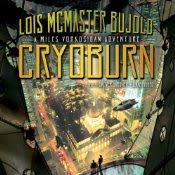
Cryoburn keeps readers guessing


Cryoburn (2010)
by Lois McMaster Bujold
Blackstone Audio, Inc.
Narrated by Grover Gardner

Reviewed by Clare Deming

I don't know how she does it. Lois McMaster Bujold weaves engaging characters, twisted plot lines, and fascinating social ideas together like few other authors can. By the end of one of her novels, you realize that every seemingly trivial piece of information was essential. While at the same time, you can never quite guess the ending. Her newest Vorkosigan adventure, Cryoburn, is no exception.

Miles Vorkosigan - former mercenary commander, former Imperial Security agent and physically handicapped son of Count Errol Vorkosigan - becomes entangled in another investigation as Imperial Auditor for the Barrayaran Empire. On the planet of Kibou-daini, citizens are obsessed with forestalling death and consign themselves to cryostorage. Their bodies are preserved until a cure is found for illness, injury, or just old age. Assigned to attend a scientific conference on cryonics, Miles is on the lookout for suspicious business dealings that may impact Barrayar. Those who have read previous Vorkosigan novels will remember that Miles is intimately familiar with cryostorage techniques, having undergone the life-preserving procedure himself after taking a needle grenade to the chest.

In the course of his meandering investigation, Miles befriends a runaway boy, Jin Sato, and his menagerie of creatures. After Miles is not-quite kidnapped by a faction of domestic terrorists, Jin inadvertently leads him to an underground cryostorage facility that exists to benefit those who cannot afford the services of the large corporations. The situation is complicated by politics - for each preserved cryo-corpse still retains voting interests on Kibou and these shares are bought and sold by various groups. Once Miles spots an anomaly he cannot let it go. When he discovers that Jin's activist mother may have been illegally frozen to get her out of the way of a cryo-corp's ambitions - he feels obligated to help, even though it may have no direct bearing on Barrayaran interests. The plot spirals into more convoluted scheming from there, with Miles always at the heart of it.

The story is told through the point-of-view of Miles, Jin, and also Armsman Roic, who has featured in previous Vorkosigan stories. The book is narrated by Grover Gardner, and I have enjoyed his performances of the other Vorkosigan audiobooks put out by Blackstone Audio. To me, he is the voice of Miles, and I appreciate it when a publisher is consistent with their narrator for an ongoing cast of characters. There were a few sections of dialogue where I had minor difficulty in following each character's speech, but this did not distract me much.

While this may not be the strongest Vorkosigan novel that I've read, nor my favorite, it is pulled together by an ending that is part punch-in-the-gut, part tear-jerker. Suddenly the subject matter of the relatively light-hearted investigation becomes critically relevant to Miles' future. The clues were all there, but Bujold never hits you over the head with them. If you've never read any of the Vorkosigan books by Lois McMaster Bujold, then Cryoburn is not the one to start with. But if you have read them, it's a must read and sets the stage for a new chapter in Miles' life.

Thursday, May 27, 2010

KS Augustin talks about characterization

It is my pleasure to introduce my first ever guest blogger on SFOO, KS Augustin. Let her entertain you and make you think while finish packing for BayCon. She promised not to trash the place while I'm gone. I don't know. I just might be out of a job when I get back. :)


Firstly, my thanks to Ann for letting me post to her blog.

My husband, J, has a skill I don't have and one I'm terribly envious of. (Forgive the dangling participle, and let's move on.) He reads in three languages: Polish, English and Russian. At the moment, he's reading a Polish anthology of science-fiction from a few years back (it contains an early short story by Jacek Dukaj), and one story in particular both intrigues and repels him.

Now, before I continue, I should explain that J's reading habits are confined to hurried snatches as he plies the ways between two countries on an almost daily basis. In between reading, he has to know where his passport and entry cards are, position himself strategically in the bus, and be ready to fly out the doors and dodge the crowds of meandering tourists as they wander their somnambulist paths from one tour-guided resort to another. Occasionally, he also has to instruct newer Immigration officials on how to process his visa (a most diplomatic process). And he's on a clock. So, he's not what you'd call a relaxed reader.

Currently, he's frustrated. "This story I'm reading is great," he tells me. "The technology is very interesting and the premise is novel. I haven't read a setting like this before. But the characters! There are three main characters, and you can't tell them apart. They're all supposed to do different things, but they're blurring together in my mind. I'm getting very confused. You're a writer. Is it me? Explain this to me."

I love science-fiction. I adore it. I credit my remaining sanity to having science-fiction books available to me while I was growing up. (Living opposite a library didn't hurt either.) But, in my opinion, if there's one area where science-fiction falls down, this is it. Characterisation. When reading characters with similar characteristics it's difficult to tell them apart within stories not just across them. A joke I have that will put you all off side is that George Clooney was perfect to play Kelvin in Lem's Solaris (2002) because both the character in the book, and Clooney, are so wooden.

"This is where romance has it all sewn up," I told my husband. "As a result, being a romance reader as well, I'm completely spoilt. The characters tend to be drawn to such a degree, in such detail, that I only need to be given a fragment -- "a flash of emerald eyes", "the hint of a dimple", "a vase crashing against the wall" -- to know which character did it and what they're probably thinking."

"Ah," he said, "that's what's missing. The technology is there, but I can't get a feel for any of the characters. They're not described, no quirks are outlined. They are just three guys with different names, all interchangeable."

Ann has detailed in a previous post of hers why she prefers male sf writers. And lots of commentators chimed in to come up with female sf authors who don't touch romance. (There was a bit of cheating in that list, as you well know.) I myself have an sf novel currently on submission that doesn't contain any romance, as you'd probably define it. But, boy oh boy, what you learn when you put it in! And that learning keeps on giving, even when you don't focus exclusively on it.

Romance is not merely about the kissing and the sex. Romance is about the psychology of the people involved and how they try to establish connections while the universe is against them. What a lot of sf writers have forgotten, in my opinion, is that you take yourself with the technology. We have PCs and tablets and mobiles and what-have-you. They were all originally meant to be productivity aids. And what have we done with them? We've connected. We've commented. We've hated. We've loved. We've laughed. You are connecting with me right now, drawing conclusions about what kind of person I am, whether you would like the kind of stuff I write, whether you would like *me*, all separate to―and yet an intrinsic co-effect―of the technology that's delivering these words to you. To say that we can have one (the setting) without the other (the human connections) is to live in sterility, where one primate-shaped block can easily be exchanged for another, without any harm coming to the unfolding storyline. Such thinking debases our individual and precious humanity, reducing us all to ciphers.

Romance teaches us that everyone has the potential for intimate connection. Science-fiction teaches us the wonder of what-if. If that isn't one of the most perfect matches ever thought of, I don't know what is.


COMPETITION: I'm giving away two copies of IN ENEMY HANDS at my blog, Fusion Despatches [http://blog.ksaugustin.com]. To be in the drawing, stop by and comment at the Competition post, telling me at which blog you read about my book. You have till 30 June!

Kaz Augustin is a Malaysian-born writer of science-fiction, romance, and permutations of the two. Her website is at www.ksaugustin.com and she blogs at http://blog.ksaugustin.com You can also find her on Facebook and Twitter; just look for "ksaugustin".


vote it up!

Tuesday, March 2, 2010

Female spec fic writers and romance in sf/f

What a tremendous response to my questions, "Why do I read more male SF writers?" posited last week. There were so many great suggestions (I did ask for them) of speculative fiction authors who happen to be female that I thought I would compile a list for my readers from the comments given last week. I love lists.

But before I dive into the list, I'd like to point you in the direction of Robert Appleton's posts on Romance: Bookvana and The Galaxy Express. Robert Appleton explores the topic of romance in speculative fiction and comes at it from a unique perspective, that of a male writing romantic speculative fiction. It's definitely worth checking out. There's also a book giveaway tied to the first blog I cited.

Now, the list, in no particular order, of speculative fiction authors who were mentioned that I should read if I want spec-fic without romance. Some of the commenters may have fudged a bit on the no-romance thing, but the list is still populated by authors they enjoy reading.


Mary Rosenblum
Octavia Butler
C.J. Cherryh
Connie Willis
Lois McMasters Bujold
Anne McCaffrey
Madeleine Le'Engle
Ursula K. LeGuin
Sharon Shinn
Andre Norton
Elizabeth Moon
Jo Clayton
Kathleen Ann Goonan
Julie Czerheda
Joan Vinge
Jacqueline Carey
Janet Kagan
Nancy Kress
Susanna Clark
Chris Moriarty
Linda Nagata
Robin Hobb
Steph Swainson

And the following list from Nancy Jane Moore:

Gwyneth Jones
Laurie J. Marks
Vonda N. McIntyre
Anne Harris
Brenda Clough
Sarah Zettel
Rebecca Ore
L. Timmel Duchamp
Sue Lange
Sheri Tepper
Suzette Haden Elgin
Suzy Charnas
Nisi Shawl
Nicola Griffith
Kelley Eskridge
Kelly Link
Mary Gentle
Lisa Tuttle
Molly Gloss
Andrea Hairston

And one commenter suggested looking at Women Writing Sci-Fi, Your Picks and Tip Tree Award winners.

That ought to keep us busy supporting female spec-fic writers! And don't forget to check out all of the fine ladies I've interviewed. A complete list can be found to the right.


vote it up!

Saturday, February 27, 2010

M.K. Hobson on the grind and glory of writing


Meet Mary, aka M.K. Hobson. She's a creator of excellent humorous science fiction and fantasy, a member of Broad Universe and great fun to kick around with. Her first novel, Native Star debuts this fall closely followed by the second in the duology, The Desired Poison. She's the first to experience an interview with me face to face with my Blackberry recording. Email interviews are less work (for me, at least), but they're less interactive. See what you think.

(Photo by James W. Fiscus)

AW: When and how did your journey to speculative fiction begin? Both as a reader and a writer?

MKH: I definitely started reading speculative fiction quite young. Mostly starting with fantasy. Well, there was TV, obviously. I loved Fantasy Island. That was my favorite TV show when I was a kid. I thought Mr. Roarke was so freaking sexy. He was like my first crush I ever had. The first fan fic I ever wrote was fantasy island fan fic. That's a little embarrassing. I started reading, Ursula Le Guin, (The Earth Sea Tales were huge when I was probably 10, 11), a lot of Piers Anthony, which I just thought was absolutely hilarious. I thought the Xanth books were the sine qua non of fantastic, wonderful writing.

I found a little bit of what I liked in everything. I liked the humor of the Xanth books. I liked the beautiful writing of the Ursula K. Le Guin books. I liked the historical detail of the Little House on the Prairie books. But it was all just pieces. So, I guess, as a writer, I wanted to take all the elements that I really liked and make something out of them that I wanted to read.

AW: So when did you start writing?

MKH: I remember I used to write in notebooks when I was probably seven or eight. I would write stories and novels, as long as a novel was for me at that age in lined notebooks. When I was 10 or 12, my Mom brought home an Ozborn word processor. Remember those Osborn word processors, there was no operating system on it, you had to insert a floppy drive in it for it to have an operating system. She brought this thing home and I was agog. Actually, there was an intermediate stage between the notebook and the word processor, my Mom had a Selectric typewriter. There was something magical about typing.

And then she brought home the word processor. I just wanted to be on that thing all the time.

AW: Does it seem to you that women authors tend to put romance into their fiction? I believe there are more men reading SF than women so I write for them. And I find that I read mostly male authors. Is it a struggle for women to write for men?

MKH: It's not just romance. Women write about relationships.

In a lot of the sci-fi short fiction I've written, I've made conscious decisions keeping a male audience in mind. One of the stories I wrote for F and SF is called "Powersuit," and it is just a humorous little science fiction piece about a guy and his AI and it's told from a masculine point of view. It's a very masculine science fiction story and I found myself making choices in that story that I actually question like, 'I'm not really sure I like the way I'm depicting this woman in this story because she's kind of your typical sex object a bit,' but for some reason I was thinking that that's the audience that I'm writing for so I'm going to go a little more in that direction. And again, I don't know if that's the right choice. I don't know if that's an honorable choice to make but I think what you've put your finger on is very real.

And I definitely think that women are much more readers of fantasy as a category. I agree, men or women writing science fiction don't tend to think of women as being their readers. They follow the tropes and the expectations of what they think a male reader is going to want.

We live in a patriarchal culture; men are better at writing to the expectation of what is good writing. What is "good writing" is what is taught in colleges and what is decided on by critics. And critics and professors are mostly male.

There are female science fiction writers like Mary Rosenblum, for example. Louise Marley is fantastic. And Brenda cooper. I can think of four or five female science fiction writers in the Pacific Northwest alone, who are very good.

It's interesting, too, that they all write under female names. When I started writing science fiction, I very carefully chose a gender-neutral pseudonym because at that point I was writing a lot more sci-fi than fantasy. I thought that I had to do that to attract the male audience. Now when someone goes by their initials, they're assumed to be a woman.

I would love to hear about what those authors had to struggle with in terms of the expectations because they all write very hard science fiction.

AW: Where do you stand on the Google gobble?

As far as I can tell, it mostly affects people who already have stuff in print. As a relatively new writer, going through and looking at what I had in the Google database, it was pretty limited. It's a really hard question because I have many, many, many a time benefited from the Google search of books, to look up a citation or something. I'm not reading the whole book. The question becomes would I have gone out and bought the book to get that information? No. Is the world a better place because I'm able to find that information? I think so. It's definitely a better place for me. How much is it really impacting the people that actually put in the work? That's the question. Because, like I said, I wouldn't have gone out and bought the book so they're not losing any money on me. But I think over the aggregate it is an issue.

It's part of a much larger issue which is as creative individuals, as creators, who take the product of our mind and hope to get some tangible benefit out of it, we're being asked more and more to give a lot of our stuff away free, it's that loss leader mentality. And the problem with that is that there's just so much being given away for free. I do a lot of the research into class and class consciousness and it seams to me the creative people are being asked to sacrifice the most. And they're the ones who are already getting to be the most marginalized. Where we were once paid for our stories, now we're expected to be glad of and settle for the exposure. That disturbs me.

How that applies to Google? I think that Google's the camel's nose in the tent. We still have bills to pay. If I knew that I was going to have my housing paid for and my healthcare paid for and I lived in some kind of socialist paradise, I would say fine, I will just write beautiful things and everyone can read them, but we don't live in that world. We live in a horrible free market economy.

AW: Your process isn't linear. Can you describe it for my readers?

MKH: It comes to me in bits and pieces. I don't like the whole, 'it's my muse, it's my muse,' I think that's silly but definitely nothing comes to me and is revealed all at once. Light shines on different parts. And I think, "Oh, yeah, that would totally happen between those characters," and so I would write that scene. And that illuminates another area. For me, approaching a story is like walking thru a dark room with a flashlight. There was an Atari game called adventure. And u would go into this dark room and you would know nothing about the room or the maze or anything until you've gone through it. Once you've gone through enough of the maze, then things are revealed to you. I have no idea what a story is going to be until I start walking through it with my flashlight and then I know what feels right, like choosing the solid stepping stone to cross the river.

AW: Does it ever get away from you? How do you organize all the bits and pieces?

MKH I get very frozen at forks in the road. It's a lot like the iceberg, 95% is cogitating and working things through, and then 5% is writing. For me, the process is grinding; thinking as far ahead as I can, like several moves ahead in a chess game to figure out which way to go. You have to get to that one moment that stops you in your tracks.

AW: Then you work backwards sometimes?

MKH: Yeah, and it can take a long time to find the right course. I think a lot of people have this sort of process but it's not talked about as much. Writing 1K words a day is easier to blog about.

AW: I think it goes back to that inspiration thing we discussed earlier. If we're not inspired and crank out words to make a quota, it can be fodder that never makes the cut.

MKH: I never get big inspirations. I don't get inspired for a whole book. I get inspired for a scene. I envision a conversation or a fight scene.

AW: Do you start with plot, world, situation or character?

MKH: I think my first foundation of what I write is the "what if?" or the juxtaposition of two odd concepts. Like my book has 19th century America with magic. Taking two disparate concepts and fitting them together was very interesting to me. In my short fiction it's often not only juxtaposing different concepts but exploring interesting things in a different light. Like one of the stories I'm doing right now is about 1930s films with magic – a fantasy element to it. I find the secret true story thing fascinating. Everybody wants the real story to be more interesting than it actually was.

Learn more about M.K. Hobson.


vote it up!